

Boat storage cost in the Midwest runs anywhere from $300 to $1,800 or more per season for storage — a range wide enough to be almost meaningless without context. What you actually pay depends on where you live, what type of storage you choose, how big your boat is, and whether you’re storing through a marine shop, a dedicated storage facility, or a marina. This guide breaks down every storage option available to Midwest boaters with real pricing from real facilities — so you know what to expect before you make the call.
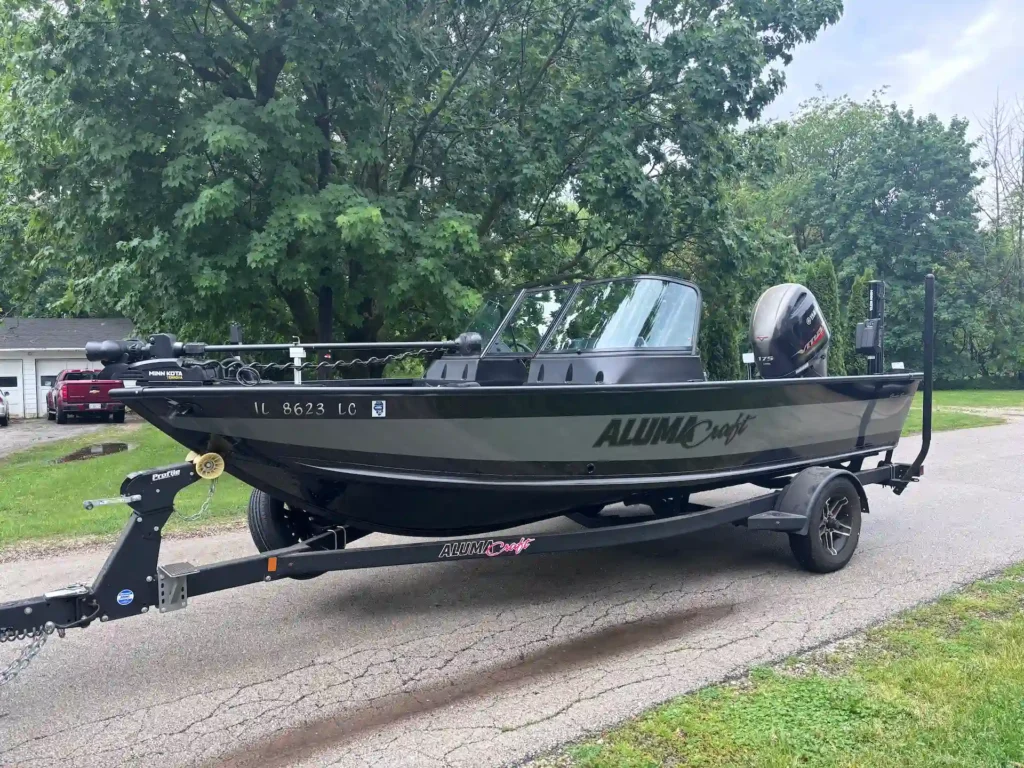
My Alumacraft 185 Competitor lives next to my garage in a carport I bought specifically for the boat. It’s not ideal for northern Illinois winters but it’s worked out well as long as I’m thorough about winterization — rodent deterrents, proper cover support, the works. One thing I didn’t anticipate when I was shopping storage options was accessible power. I didn’t want to pull the boat out of storage every time I needed to charge the batteries or run a quick check before a trip. It sounds like a small thing until you’re doing it in February. Before you commit to any storage facility — indoor or outdoor — ask specifically whether shore power is available at your unit. A lot of Midwest facilities don’t offer it, and it matters more than most first-time storage shoppers realize.
The Five Types of Boat Storage in the Midwest
Midwest boat owners have more storage options than most people realize — and the differences in cost, protection, and convenience are significant. Here’s what’s available and what each option typically costs:
| Storage Type | What It Is | Typical Midwest Cost | Best For |
| Outdoor storage — uncovered | Gravel or paved lot, no cover | $300 – $600 per season | Budget-conscious owners — fishing boats and older vessels |
| Outdoor storage — with shrink wrap | Outdoor lot plus professional shrink wrap | $600 – $1,100 per season | Good all-around protection at moderate cost |
| Indoor unheated storage | Enclosed building — no climate control | $700 – $1,200 per season | Better protection than outdoor — adequate for most boats |
| Indoor heated storage | Climate-controlled enclosed facility | $900 – $1,800 per season | High-value boats — wake boats, luxury pontoons, newer fiberglass |
| Rack storage | Forklift-accessed stacked indoor racks | $800 – $1,500 per season | Space-efficient — common at larger marina facilities |
| Marina slip — seasonal | In-water dock rental for the season | $1,700 – $6,000+ per season | Boaters who want the boat in the water all season |
The right option depends entirely on your boat’s value, your budget, and how much protection you genuinely need. A 15-year-old 16-foot aluminum fishing boat stored outdoors with a good cover survives a Wisconsin or Minnesota winter just fine. A two-year-old $80,000 wake boat deserves heated indoor storage. The math is different for every boat owner.
O
Outdoor Boat Storage Costs in the Midwest
Outdoor storage is the most common and most affordable option for Midwest boat owners. Most facilities charge either by the linear foot of boat length or a flat seasonal rate. Here’s what that looks like across different Midwest markets:
| State / Region | Outdoor Storage — Seasonal Rate | Notes |
| Wisconsin — Northwoods | $350 – $550 per season | Fills fast — book by September |
| Wisconsin — Southern (Lake Geneva, Milwaukee area) | $400 – $650 per season | Higher demand near Lake Michigan corridor |
| Minnesota — Brainerd and Alexandria | $300 – $500 per season | Competitive market — many options |
| Minnesota — Twin Cities metro | $400 – $650 per season | Higher land costs push prices up |
| Illinois — Chicago suburbs | $450 – $750 per season | Premium market — limited lake-area storage |
| Michigan — West shore (Lake Michigan) | $400 – $650 per season | High demand near Great Lakes access |
| Missouri — Lake of the Ozarks | $350 – $600 per season | Longer season reduces pressure slightly |
| Kentucky — Kentucky Lake region | $300 – $500 per season | Milder winters — lower storage demand |
Most Midwest facilities that charge by the linear foot run $10 to $20 per foot per season for outdoor storage. A 20-foot boat runs $200 to $400 and a 24-foot boat runs $240 to $480. Add shrink wrapping at $20 to $30 per foot and outdoor storage with full wrap protection runs $800 to $1,200 for a typical Midwest fishing boat or pontoon.
Indoor Boat Storage Costs in the Midwest
Indoor storage is where Midwest pricing diverges most significantly from the national average — because in a state like Minnesota or Wisconsin, indoor storage isn’t a luxury. It’s a meaningful insurance policy against a seven-month winter. Here’s what indoor storage actually costs across Midwest markets:
| Storage Type | Typical Midwest Cost | What’s Usually Included |
| Indoor unheated — seasonal | $700 – $1,200 flat rate | Enclosed building, basic security |
| Indoor heated — seasonal | $900 – $1,800 flat rate | Climate control, often includes spring startup |
| Indoor heated — monthly rate | $150 – $350 per month | Month-to-month flexibility — higher effective rate |
| Rack storage — indoor | $800 – $1,500 flat rate | Forklift access, space-efficient, good for smaller boats |
| Early booking discount | $75 – $150 off | Many shops discount for September payment |
| Spring startup included | Value: $150 – $300 | Often bundled with premium indoor packages |
One real-world Wisconsin example worth knowing — Sterling Marina in central Wisconsin serves Lake Winnebago and surrounding lakes with pickup and delivery service. Fall pickup from Big Green Lake runs $139 and spring delivery runs $139. From Lake Winnebago the rate increases to $189 each way. These pickup fees are separate from storage costs and are worth factoring into your total seasonal budget if you’re using a shop that doesn’t store on-site.
Marina Slip Costs in the Midwest
A marina slip keeps your boat in the water all season — the most convenient option for boaters who want to go from car to boat without hitching a trailer. It’s also the most expensive storage option by a significant margin.
| Lake / Region | Seasonal Slip Cost | Notes |
| Lake Minnetonka, MN | $1,700 – $10,000+ per season | Widest range in the Midwest — small fishing slips to premium Wayzata Bay |
| Lake Michigan — Racine / Kenosha, WI | $3,000 – $5,000 per season | South Bay Marina — 30-ft slip around $3,050 |
| Lake Michigan — Port Washington, WI | Transient $1.96/ft per night | Seasonal rates available — contact marina directly |
| Lake of the Ozarks, MO | $1,500 – $4,000 per season | Highly variable by cove and amenities |
| Kentucky Lake, KY | $1,200 – $3,500 per season | Competitive market — more options than most Midwest lakes |
| Fox River / Lake Winnebago, WI | $1,500 – $3,500 per season | Central Wisconsin marina market |
Marina slips in the Midwest typically include electric and water hookup. Many include pump-out service. Premium marinas add amenities like pools, restaurants, and ship stores. The cost per convenience unit is high — but for boaters who use their boat frequently all season, eliminating the trailer launch every trip has real value.
The Real Cost of Storing at Home
I store my Alumacraft in a three-sided carport next to my garage — covered from rain, snow, and sun, but open to whatever the Midwest decides to throw at it. I didn’t bother with a boat cover for the first couple of seasons since the carport roof kept the weather off. Then we had a major winter storm — no snow, just wind — and everything in that carport was coated in dirt. The boat, the seats, the electronics, all of it. After that I picked up a universal boat cover on Amazon for around $100 and haven’t looked back. I use it in storage and whenever I’m parked overnight at a hotel on a fishing trip. It was a naive assumption that a roof was enough — but an easy and cheap fix once I figured it out. If you’re storing under a carport or open structure, don’t skip the cover.
Home storage — in a garage, pole barn, or on a trailer in the driveway — is the lowest-cost option and the most overlooked. The hard costs are minimal — a quality boat cover runs $200 to $600 depending on boat size, and a set of support poles to prevent snow load collapse runs $50 to $150. That’s $250 to $750 one-time versus $300 to $1,200 every season for commercial storage.
The real costs of home storage are the ones Midwest boat owners don’t always anticipate:
- Rodent damage — mice nest in boat upholstery, chew through wiring, and cause hundreds to thousands of dollars in damage in a single Midwest winter. A boat stored in a garage or pole barn needs mouse deterrents — traps, repellent, and sealed entry points around any wiring penetrations
- Cover failure under snow load — a flat or low-pitch cover on a 22-foot boat under a heavy Wisconsin or Minnesota snowpack can collapse. Support poles or a custom frame prevents this
- UV degradation on uncovered trailered boats — boats stored outdoors on a driveway without a cover suffer significant UV damage to upholstery, canvas, and gel coat over a seven-month Midwest winter
- HOA and municipal restrictions — many Midwest suburban communities restrict long-term boat storage on residential properties. Check local ordinances before assuming home storage is an option
What Midwest Boat Storage Actually Costs by Boat Type
To make the pricing concrete — here’s what a full seasonal storage decision looks like for the most common boat types on Midwest lakes:
| Boat Type | Home Storage | Outdoor + Shrink Wrap | Indoor Unheated | Indoor Heated |
| 16-ft aluminum fishing boat | $50 – $150/yr (cover) | $550 – $800/season | $700 – $950/season | $900 – $1,200/season |
| 20-ft fiberglass fishing boat | $200 – $400/yr (cover) | $700 – $1,000/season | $800 – $1,100/season | $1,000 – $1,500/season |
| 22-ft pontoon | $200 – $500/yr (cover) | $750 – $1,100/season | $850 – $1,200/season | $1,100 – $1,600/season |
| 21-ft sterndrive (I/O) | $200 – $400/yr (cover) | $750 – $1,050/season | $850 – $1,150/season | $1,100 – $1,600/season |
| 24-ft wake boat | $300 – $600/yr (cover) | $900 – $1,300/season | $1,000 – $1,400/season | $1,300 – $1,800/season |
How to Save Money on Midwest Boat Storage
- Book in August or September — the best indoor facilities in Wisconsin, Minnesota, and Michigan fill by early October. Waiting until November means fewer options and sometimes higher late-booking rates. Many shops offer $75 to $150 early-booking discounts for September payment
- Bundle storage with winterization — most Midwest marine shops that offer storage also offer winterization. Bundling saves one pickup or drop-off trip and some shops discount the combined service
- Ask about spring startup inclusion — premium storage packages at many Midwest shops include a spring startup inspection valued at $150 to $300. If it’s included you’re effectively getting service for free
- Consider a seasonal contract over month-to-month — monthly storage rates cost 10 to 20 percent more annually than flat seasonal contracts. If you know you’re storing October through April commit to the seasonal rate
- Measure your boat with the trailer — most facilities charge by overall length including the trailer. A 20-foot boat on a trailer might measure 24 to 26 feet overall. Know your actual stored length before calling for quotes or you’ll get a surprise on the invoice
From the Water
Storage isn’t the most exciting part of boat ownership — it’s not fun to spend money on, not fun to research, and not fun to renew every fall. But after 40 years of Midwest boating I can tell you it’s one of the decisions that separates the boat owners who are ready on opener morning from the ones still dealing with winter damage in May. If it were up to me we’d all have a big heated garage with a lift, power outlets, and a mini fridge. That’s not most people’s reality — mine included. So do the research, ask the right questions before you sign anything, and don’t assume the cheapest option is the right one just because it saves you a few hundred dollars in October.
Frequently Asked Questions About Midwest Boat Storage
How much does boat storage cost in the Midwest?
Midwest boat storage runs $300 to $1,800 or more per season depending on storage type, boat size, and location. Outdoor uncovered storage starts around $300 to $600 per season. Outdoor storage with shrink wrap runs $600 to $1,100. Indoor unheated storage runs $700 to $1,200. Indoor heated storage runs $900 to $1,800. Marina slip rental starts around $1,700 and goes up significantly on premium Midwest lakes like Lake Minnetonka.
Is indoor boat storage worth it in the Midwest?
For boats valued at $30,000 or more — generally yes. Midwest winters are long and cold enough that indoor storage eliminates freeze risk entirely, prevents rodent damage, and significantly reduces UV and moisture deterioration over a seven-month off-season. The premium over outdoor storage typically runs $300 to $600 per season — money well spent on a high-value vessel.
When should I book boat storage in the Midwest?
August or September for indoor storage — especially in Wisconsin, Minnesota, and Michigan lake communities where indoor capacity is limited and demand is high. Outdoor storage has more flexibility but the best facilities still fill early. Calling in late October and expecting to find heated indoor storage available in a Wisconsin lake community is optimistic.
Can I store my boat at home in the Midwest?
Yes — if you have space and no HOA or municipal restrictions. Home storage is the lowest-cost option with a quality cover and rodent deterrents. The genuine risks of home storage in the Midwest are cover collapse under heavy snow load, rodent damage over a long winter, and UV degradation on uncovered boats. A quality cover with support poles addresses most of these risks.
Do Midwest boat storage facilities include winterization?
Many do — especially marine shops that offer combined winterization and storage packages. Bundling is usually the most cost-efficient option since you save a pickup or drop-off trip and some shops discount the combined service. Always confirm exactly what’s included in a storage package — winterization, spring startup, and shrink wrapping are commonly listed separately even when sold together.
Find Boat Storage Near Your Lake

Author: Aaron Drendel
A US Navy veteran, Aaron has worked as a commercial Salmon fisherman in Alaska, canoed 2,500 miles down the Mississippi River from source to sea, and is a lifelong fisherman in the Midwest region. He founded Find Boat Services to ensure fellow boaters across the Heartland spend less time on the trailer and more time on the water.



Leave a Reply